Two factions with unique fleets and firing patterns: Blue (Cross) and Red (Square)
15×15 grid with drag-and-drop ship placement and randomise
Private lobbies via shareable link
In-game chat
Match statistics recorded for balance tracking
Zenov's Battleships
Naval warfare, browser-based
What is this
A real-time, two-player battleships game played directly in the browser.
No accounts, no downloads — pick a nickname, arrange your fleet, and find an opponent.
Built as a personal project. The server runs Socket.IO over Node.js;
the client is vanilla JS with no framework.
How to play
Enter a nickname and click Join Battle
Choose a faction — Blue, Red, or Yellow — each has a unique fleet and firing pattern.
Drag ships to arrange your fleet, or hit Randomize
Create or join a match in the lobby panel and wait for an opponent. You can create a private lobby by clicking the Copy Link symbol.
Click Ready! when set. The game begins once both players are ready.
Take turns firing at the enemy grid. Sink all their ships to win.
Mouse over your opponent's name to view unsunk ships.
Factions
Note: only Blue and Red have been thoroughly tested and balanced. Other factions are experimental.
This game is a variation on the pen-and-paper game Battleships.
Nearly all rules have been changed: the grid is 15×15, and each shot fires a multi-cell pattern determined by the player's chosen Faction. Each faction also has its own distinct set of ships.
Balance is informed by Nick Berry's analysis of the classic game on DataGenetics.
The optimal shot-selection method used there — a Probability Density Function that weights unsolved cells by how likely they are to contain a ship — carries over directly.
To measure balance I built a simulator that runs both factions against each other using that strategy.
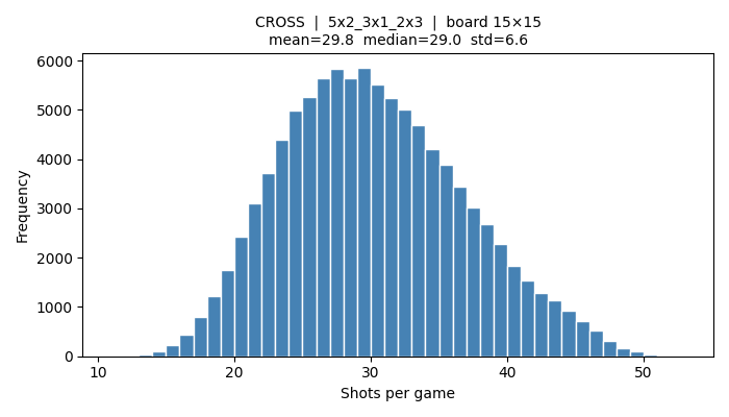
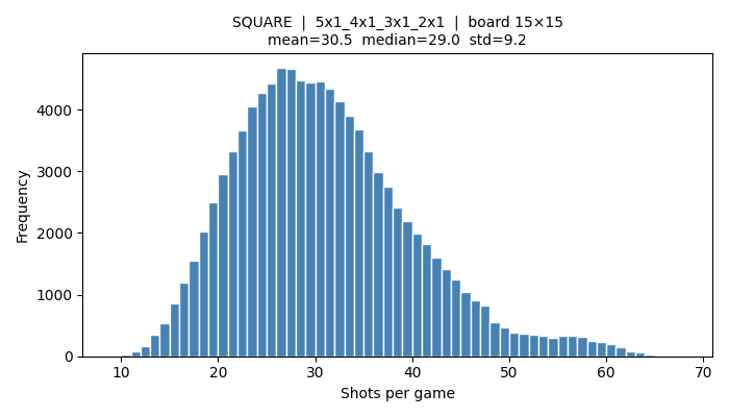
The classic game has a median length of 42 moves; Zenov's median is 29 shots, so games are significantly faster.
Blue (Cross) vs Red ships — 100k simulationsRed (Square) vs Blue ships — 100k simulations
Both matchups share a median of 29 shots, so the game is theoretically balanced for players making optimal decisions.
The Square pattern's wider standard deviation (9.2 vs 6.6) means Red games are more swingy — which may make Red slightly harder for human players in practice.
Your feedback is greatly appreciated. Thanks for playing!
Completed matches are recorded to help track game balance over time.
No personal information is stored.
Only gameplay data is kept: shots fired, hits, ships sunk, factions chosen, and match duration.